


In 2025, live news streaming via YouTube on smart TVs leaves traditional television behind and transforms news consumption in the Dominican Republic.
By: Pavel De Camps Vargas
Who’s dominating your home screen today?
It’s not traditional television. In the Dominican Republic, YouTube has taken over the television in this 2025, redefining the map of news consumption. What was once the sanctuary of the 7 and 10 o’clock news programs is now a territory of live broadcasts, real-time analysis, and debates that multiply with a click. The new newsroom is in the cloud, and the presenter is you: the viewer who comments, shares, and demands.Streaming Settles in the Heart of the Home
More than 45% of Dominican internet users already consume live broadcasts on YouTube, and more than half do so from Smart TVs, according to various studies on news consumption. This figure confirms an irreversible reality: the television is no longer passive. Now it is interactive, unpredictable, and governed by the algorithm.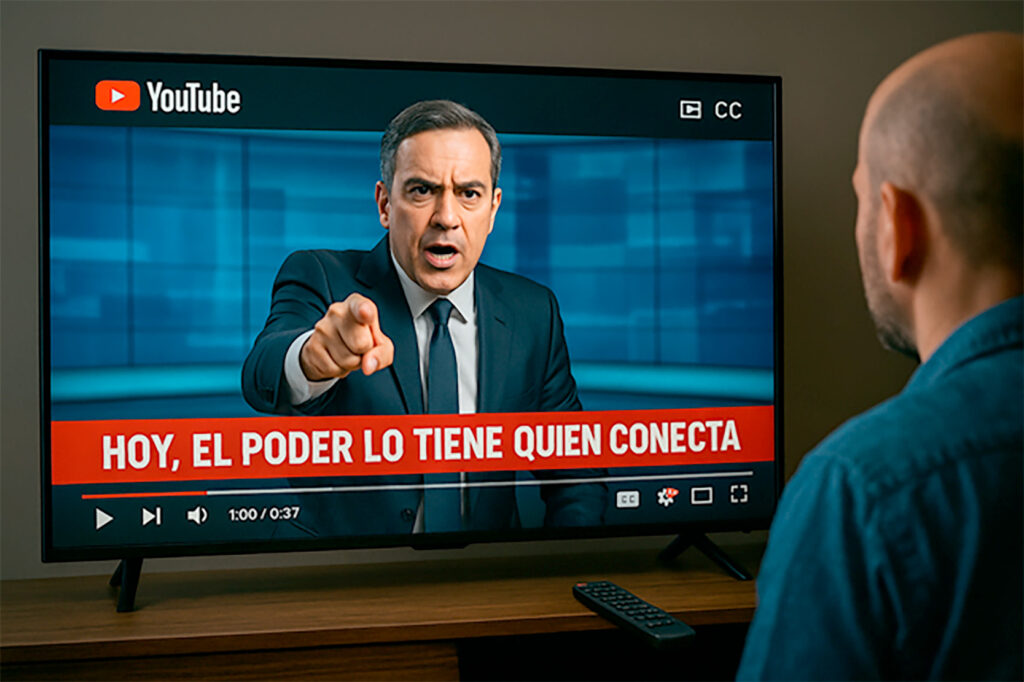
Media That Are Transforming
Current media outlets such as Noticias SIN (B+), Color Visión Canal 9 (B-), Mañanero TV (B) and CDN (C+) are the new giants of digital prime time. In addition, media outlets such as Al Tanto TV (B), José Peguero (C+), Zol FM (C+), Antoni Channel (C), Aneudys Santos (C+), Visión RDN (C), Rafael Linares Guerrero (C+) and Chala TV (C+) are rapidly climbing the rankings. The media that understood the change are reaping unprecedented audiences. Noticias SIN publishes an average of 114 videos per week, with live broadcasts, news adapted to the digital format, and breaking news coverage. Mañanero TV and Telemicro are following their example, competing not for ratings, but for views, interaction, and loyalty. The difference is not only in the frequency. It is in the closeness, in the horizontality of the message, in the power of immediate response, in the live commentary and in the human face of the content.The new information cycle: you decide when, how, and with whom
Traditional television imposes.YouTube asks and answers in real time.
From the couch, the bed, or the kitchen, the connected Dominican chooses their news as they choose their playlist: by topic, tone, style, or trustworthy face. And if they don’t like it, they change. And if they love it, they share it. And if it outrages them, they debate it in the comments. We are facing an empowered citizenry that no longer silently accepts the news script. It rewrites it live.
Smart TVs: The Final Battleground
With over 58% of households connected to the internet and 76.6% with televisions, Smart TV becomes the decisive weapon of the Dominican digital news ecosystem. And in that field, YouTube has no rival. Gone are the times when only having a channel mattered. Today, having a community, authenticity, and emotional connection matters. Media that only broadcasts loses. Those that listen, grow. Those that interact, lead. Who tells the story now? Who controls it? Who validates it? In 2025, the news is no longer seen… it is lived. The audience no longer consumes… it participates. And the television no longer belongs to the channel… it belongs to the algorithm.The changes are already happening:
- Young people don’t turn on the TV. They search YouTube.
- News goes viral before being confirmed.
- Journalists compete with influencers.
- News programs are designed for social media.
- Smart TVs are the new trench of credibility.
Is your medium prepared to appear on the screen that is being seen?
Are you producing for the digital viewer or trapped in the codes of the twentieth century?
Did you understand that the remote control is now held by YouTube? The battle for attention isn’t on channel 5 or 11. It’s on the “Skip Ad” button. The revolution will not be televised. It will be streaming. Live. On YouTube. From your Smart TV. And it has already begun.
The immediate future
The data doesn’t lie: by 2030, 95% of the Dominican population will be connected, and more than 85% of the content will be consumed in video format, mostly from smart TVs. In that future that is already emerging, YouTube will not be an alternative: it will be the public square, the visual parliament, and the national agenda. The digital media market will only reach those who dare to radically transform their production, participation, and narrative models. Artificial intelligence, content hyper-personalization, immersive environments, and predictive algorithms are already shaping what people see, feel, and believe. Meanwhile, politicians continue to bet on empty press conferences, media directors remain trapped in the rigidity of the 10 o’clock news, and journalists trained to write editorials still do not generate conversation, interaction, or community. Television as we knew it no longer exists. The usual news program has been replaced by broadcasts where the audience comments in real time and demands truth with evidence. Today, the power is not held by the one who broadcasts, but by the one who connects. Not the one who speaks, but the one who listens.What’s the point of having a channel if no one tunes in anymore?
What’s the use of having an editorial team if the script is written by an algorithm?
And what’s the point of informing if we are not able to influence or generate trust on the new screen of the people?



